Understanding Scent for Tracking and Trailing Dogs
Understanding how scent is created, how it behaves in the environment, and how weather and time affect it is fundamental for any handler working a scent dog.
Whether a dog is tracking (following ground disturbance) or trailing (following human scent carried through the air and environment), the dog is always working with scent. The difference is simply how that scent presents itself in the environment.
This article explains what scent is, how dogs detect it, and how environmental conditions affect both ground tracking and human trailing work.
What Is Scent?
Everything in the world produces scent. Every person, animal, object, and surface constantly releases tiny particles into the environment.
These scent particles consist mainly of:
• Skin cells
• Bacteria
• Body secretions
• Odour molecules
The amount of scent released is constantly changing and is heavily influenced by environmental conditions such as temperature, humidity, wind, and terrain.
When a person moves through an environment, they leave behind a complex trail of scent. Some of this scent settles onto the ground, while some becomes airborne and spreads through the surrounding area.
This is why dogs may work with their nose down when tracking or nose up when trailing, depending on where the scent is strongest.
The Dog’s Sense of Smell
Dogs possess an extraordinary sense of smell. While the exact comparison varies, it is commonly believed that a dog’s nose can be hundreds of thousands to millions of times more sensitive than a human’s.
A large portion of the dog’s brain is dedicated to processing scent information. In simple terms, dogs experience the world through their nose in much the same way humans rely on their eyes.
While humans may detect strong smells, dogs can detect extremely small traces of scent and even separate the individual components that make up a scent.
This allows them to:
• Identify individual people
• Detect old scent
• Separate one scent from many others
• Follow scent through complex environments
Human Scent
Human scent is created through several biological processes.
The human body constantly produces secretions through glands in the skin. These secretions are influenced by a person's emotional state, such as excitement, fear, or stress.
In addition to this, the human body continually sheds tiny flakes of skin.
These skin flakes are extremely important in scent work.
As a person walks through an environment:
• Skin flakes fall to the ground
• Some remain close to the footsteps
• Others are carried away by air movement
Sometimes these flakes cluster together and form what are known as “skin rafts.”
These rafts are heavier than individual skin cells and usually settle closer to where the person walked.
Because these skin particles originate from an individual person, they carry that person's unique scent signature. This is how dogs can distinguish one person from another even in areas where many people have been.
Ground Tracking vs Human Trailing
Both tracking and trailing dogs follow the scent left by a person, but they focus on different aspects of that scent.
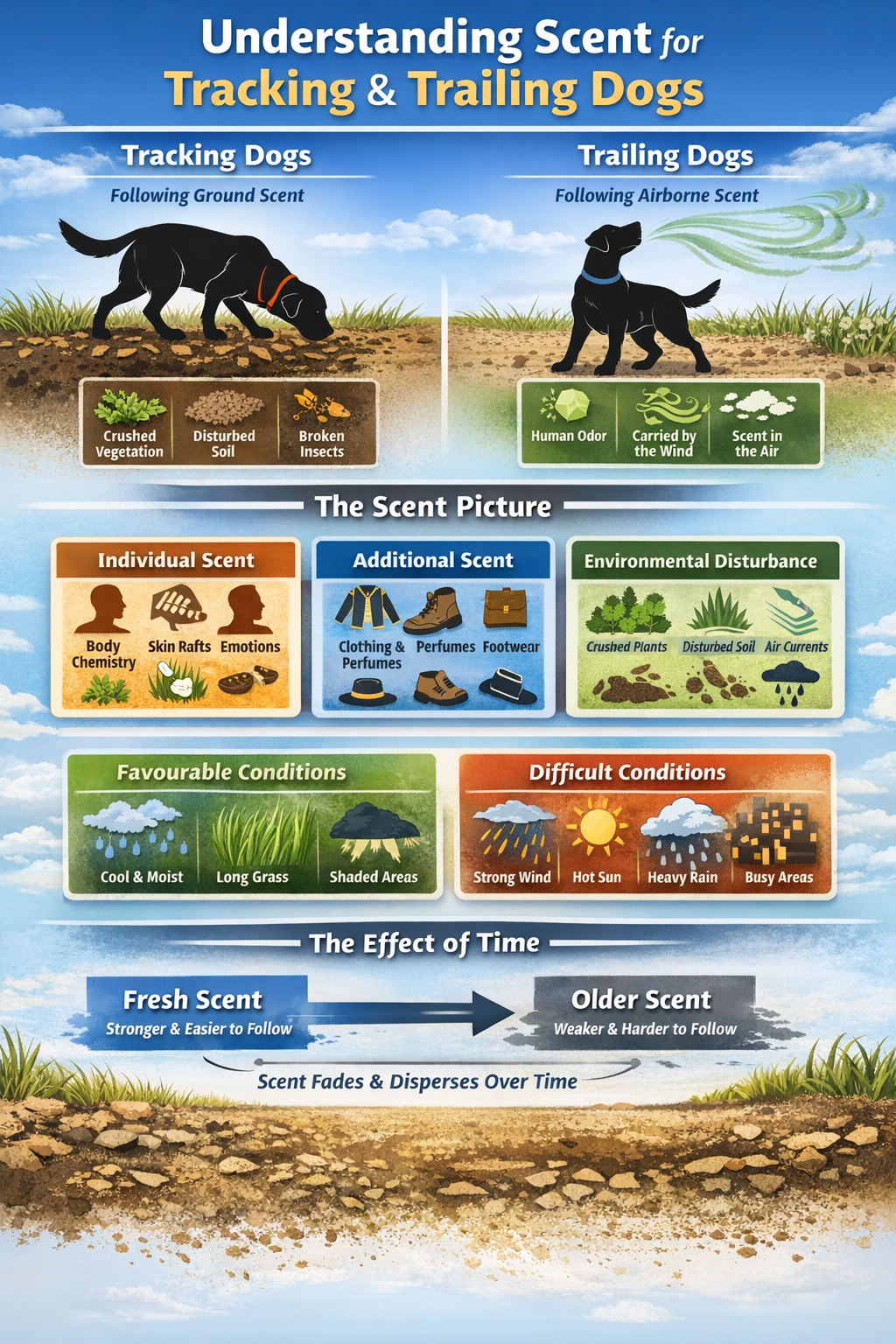
Tracking Dogs
Tracking dogs primarily work close to the ground, following the disturbance created when a person walks across the surface.
They focus heavily on:
• Crushed vegetation
• Disturbed soil
• Broken insects
• Ground disturbance
Their nose is often close to the track line because the scent is concentrated where the person physically walked.
Trailing Dogs
Trailing dogs focus more on the human scent carried through the air and surrounding environment.
Rather than staying directly on the footsteps, trailing dogs may follow scent that has drifted away from the track due to wind or air movement.
This means a trailing dog may work:
• Several metres off the original path
• With its nose in the air
• Following scent carried by wind currents
This is why trailing often appears less precise than tracking, but the dog is still correctly following the person’s scent.
The Scent Picture
When a dog follows a person, it is not simply following one type of scent.
Instead, the dog combines several scent sources into one overall scent picture.
These scent sources include:
Individual Scent
This is the natural scent produced by the human body.
It is influenced by factors such as:
• Body chemistry
• Emotional state
• Gender
• Diet
This scent remains constant and allows the dog to identify a specific individual.
Additional Scent
Additional scent comes from things associated with the person, including:
• Clothing
• Footwear
• Washing powders
• Perfumes and toiletries
• Occupation or environment
These scents may change over time but contribute to the overall scent picture.
Environmental Disturbance
When a person moves through the environment they disturb the surface.
This disturbance creates scent through:
• Crushed vegetation
• Disturbed soil
• Broken insects
• Ground pressure
Tracking dogs often rely heavily on this disturbance, while trailing dogs may rely more on drifting human scent.
Environmental Factors That Affect Scent
Weather and environmental conditions can dramatically affect how scent behaves.
Handlers should always consider these factors when working a dog.
Wind
Wind is one of the most important influences on scent movement.
Strong wind can:
• Disperse scent quickly
• Push scent away from the original track
• Create scent pools and pockets
Light wind can actually help trailing dogs by carrying scent further through the environment.
Handlers often notice dogs working off the actual track line because the wind has moved scent away from where the person walked.
Rain
Rain can affect scent in different ways depending on intensity.
Light rain can actually improve scent conditions because it:
• Prevents scent from drying out
• Keeps scent particles close to the ground
• Encourages bacterial activity
Heavy rain, however, can:
• Wash scent away
• Dilute scent particles
• Break down ground disturbance
Sun and Heat
Heat and strong sunlight accelerate scent breakdown.
Warm conditions cause scent particles to evaporate more quickly, which can make tracks much harder to follow.
Hot sunny days are often some of the most difficult conditions for scent work.
Cold and Frost
Cold temperatures can slow down scent breakdown.
However, if the ground freezes, scent may become temporarily unavailable because the bacterial processes that produce scent slow down significantly.
Once the ground begins to thaw, scent can become available again.
Favourable Scent Conditions
Some conditions help scent remain strong in the environment.
These include:
• Mild temperatures
• Moist air or light humidity
• Long grass or vegetation that traps scent
• Shaded ground protected from sun and wind
• Night time conditions with cooler temperatures
Scent often remains available for longer in these environments.
Difficult Scent Conditions
Certain environments make scent work more difficult.
These include:
• Strong wind
• Hot sunshine
• Heavy rain
• Sand or chalk surfaces
• Freshly ploughed ground
• Strongly scented vegetation
• Crowded areas with lots of human traffic
• Hard surfaces such as asphalt or concrete
Even in these conditions, well trained dogs are often capable of following scent when success might initially appear unlikely.
The Effect of Time on Scent
Time is one of the most important factors in scent work.
Fresh tracks contain a large amount of scent, which makes them easier for dogs to follow.
As time passes:
• Scent particles disperse
• Environmental factors break down scent
• Other scents cross and contaminate the track
Older tracks therefore become increasingly difficult.
However, experienced dogs can still follow scent that is many hours old under the right conditions.
In operational work, handlers must balance the urgency of the task with environmental conditions. Waiting for better conditions may help the dog, but delaying too long can allow the person to travel further away.
Final Thoughts
Tracking and trailing dogs rely on the same fundamental principle: following the scent left behind by a person moving through the environment.
The difference lies in how that scent presents itself.
Tracking dogs primarily follow ground disturbance and scent close to the track line, while trailing dogs often follow airborne human scent that has moved through the environment.
By understanding how scent behaves, handlers can better interpret their dog’s behaviour and make more informed decisions during training or operational work.
The dog’s nose is an incredibly powerful tool, but the handler’s understanding of scent and environmental conditions is what allows the team to work effectively together.