Scent Behaviour Terminology
A Practical Guide for Tracking, Trailing and Scent Detection Handlers
Understanding how scent behaves in the environment is one of the most important pieces of knowledge a scent dog handler can develop.
Many training problems that handlers experience are not actually dog problems. They are handling problems caused by a lack of understanding about scent behaviour.
Handlers see their dog leave the track line, lift its head, cast sideways, or move downwind and assume the dog is making a mistake. In many cases the dog is simply following scent exactly as it exists in the environment.
If you want to become a better handler, you must learn to understand how scent moves, settles, drifts and accumulates.
This guide will explain the key scent behaviour terms used in tracking, trailing and scent detection so you can better understand what your dog is telling you.
Why Understanding Scent Behaviour Matters
Dogs follow scent. Handlers follow dogs.
When handlers misunderstand scent behaviour they often:
• Interrupt the dog when it is correct
• Pull the dog off scent
• Give unnecessary commands
• Assume the dog is wrong when it is actually working the scent picture
The dog’s nose is incredibly accurate. If something appears unusual in the dog’s behaviour, it is usually because the scent is behaving differently in that environment.
Your job as a handler is to recognise these scent behaviours and allow the dog to work through them.
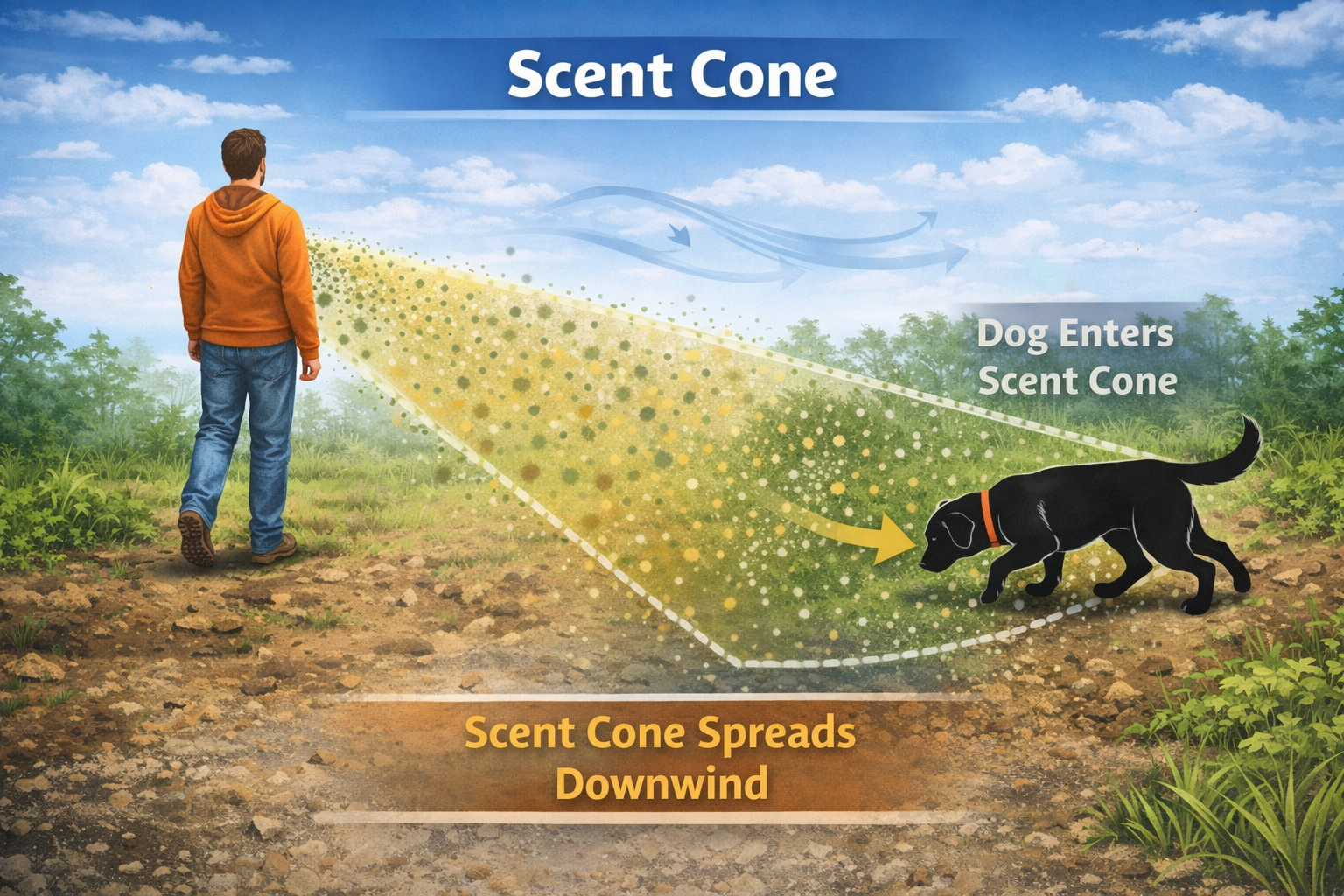
The Scent Cone
One of the most commonly discussed scent behaviours is the scent cone.
When a person stands in one place, scent particles begin to fall away from the body and settle onto the ground. As wind or air movement interacts with those particles, they begin to spread out downwind from the source.
This creates what is known as a scent cone.
Imagine an upside-down triangle starting at the source of the scent and widening as it moves downwind. The scent becomes weaker the further away you move from the source.
For dogs, this cone of scent acts like a signal pointing back toward the origin.
What this looks like during training
When a tracking or trailing dog enters a scent cone you may see the dog:
• Suddenly change direction
• Lift its head and move into the wind
• Accelerate toward the source of scent
Handlers sometimes believe the dog has left the track. In reality the dog has intercepted the scent cone and is now moving toward the strongest concentration of scent.
This behaviour is particularly common in trailing and detection work.
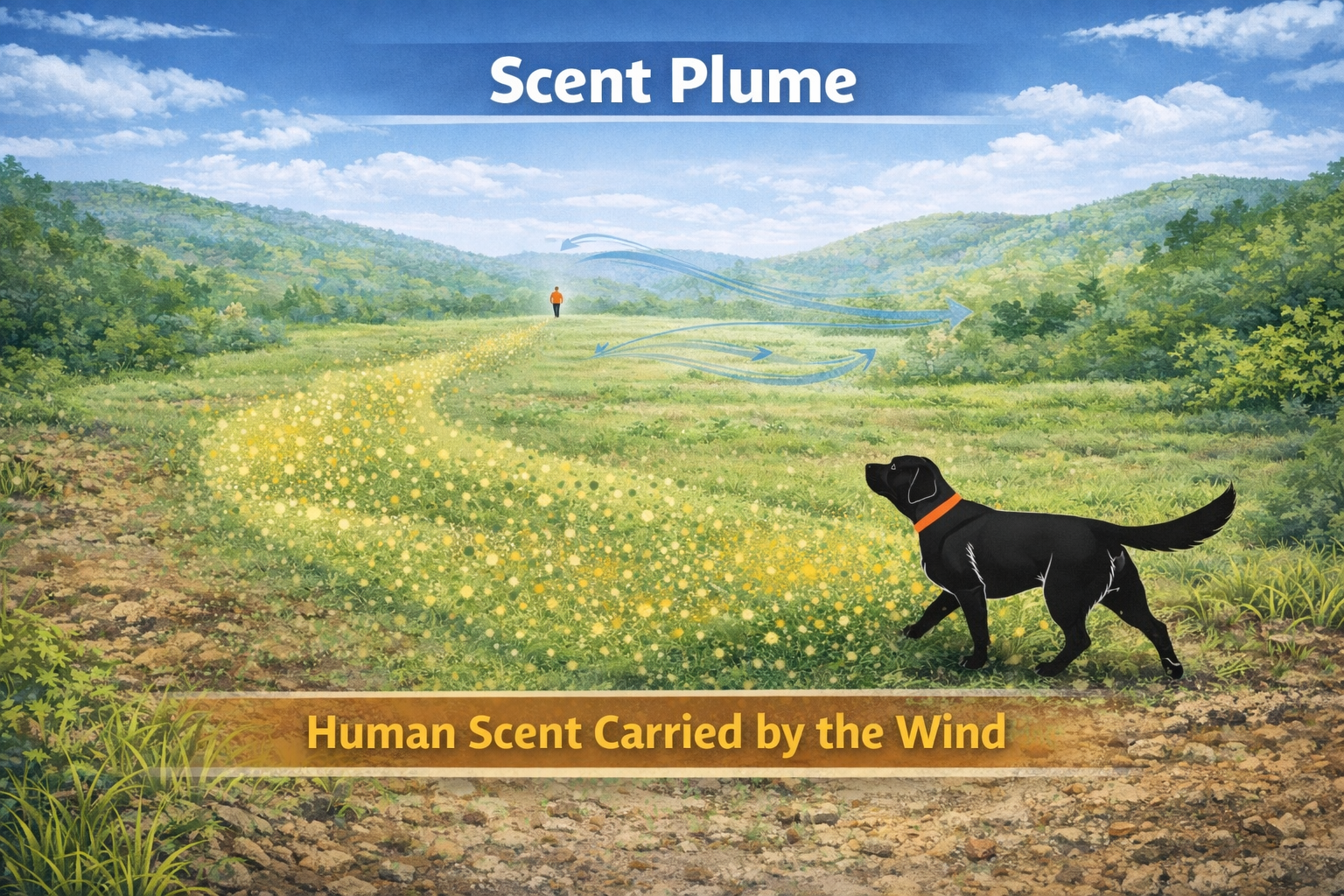
The Scent Plume
A scent plume is similar to a scent cone but usually refers to scent that is carried and stretched by wind or air currents over distance.
Where a scent cone tends to form around a stationary source, a plume is often created when scent is carried away through the air and spread across an area.
You will commonly see scent plumes in:
• Open fields
• Streets with steady wind flow
• Valleys or natural channels where air moves
The scent does not remain in a neat line. Instead it becomes elongated and dispersed.
What this looks like during training
Dogs working a plume may:
• Work with their head higher
• Move downwind rather than directly along the track
• Work in wider arcs
Handlers who only expect the dog to stay on the exact footsteps often struggle here.
In trailing work especially, the dog may be following the human scent carried by air movement rather than the exact track line.
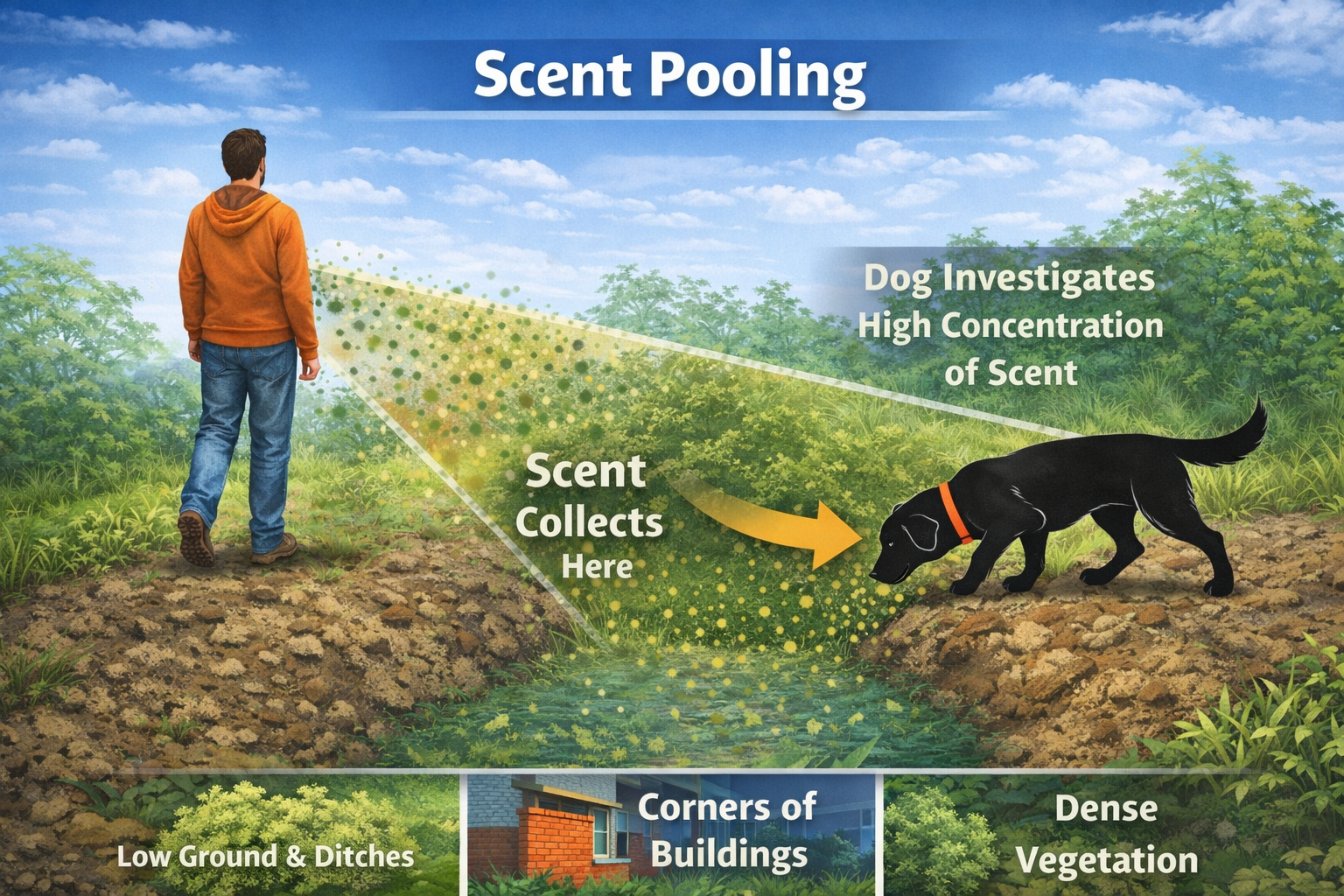
Scent Pooling
Scent does not always move smoothly across the environment. Sometimes it accumulates in particular areas.
This is known as scent pooling.
Scent pooling occurs when scent particles settle in areas where airflow slows down or becomes trapped.
Common places where scent pools include:
• Ditches and low ground
• Corners of buildings
• Dense vegetation
• Areas sheltered from wind
Because scent collects in these areas, dogs may show very strong interest in them.
What this looks like during training
Handlers may notice the dog:
• Slowing down in a particular area
• Circling repeatedly
• Showing intense sniffing behaviour
The dog is investigating a high concentration of scent.
This does not necessarily mean the person was standing there. It simply means scent has accumulated in that location.
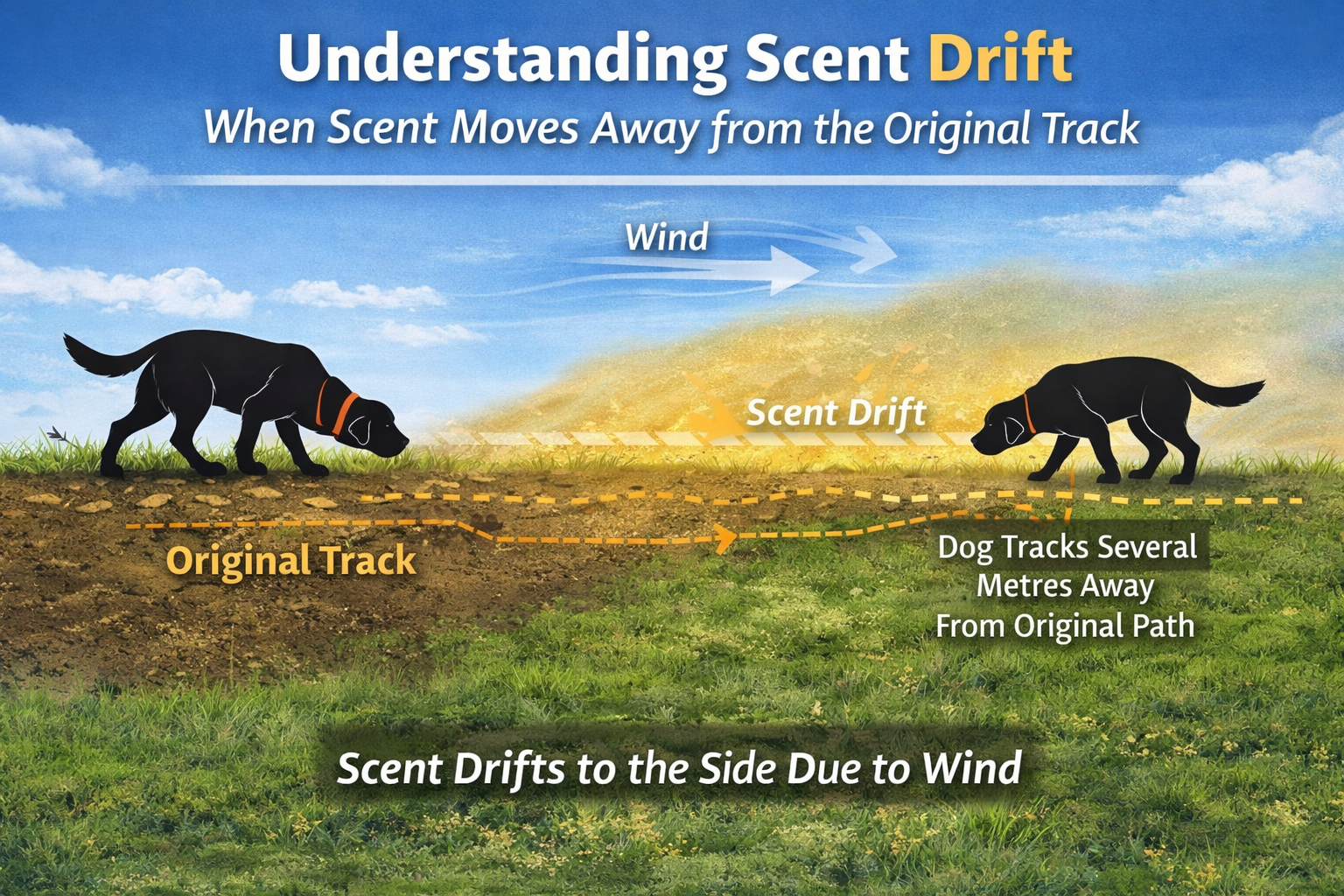
Scent Drift
One of the most important concepts for tracking and trailing handlers to understand is scent drift.
Scent drift occurs when wind or air movement pushes scent away from the original track line.
As a result, scent can move several metres away from where the person actually walked.
In some conditions scent may drift 10–30 metres or more from the original track.
What this looks like during training
Dogs may:
• Track several metres off the original path
• Move parallel to the track
• Cut corners on turns
Many handlers incorrectly believe the dog has made an error.
In reality the dog is simply following where the scent has moved.
Experienced handlers recognise this behaviour and allow the dog to work freely within the scent picture.
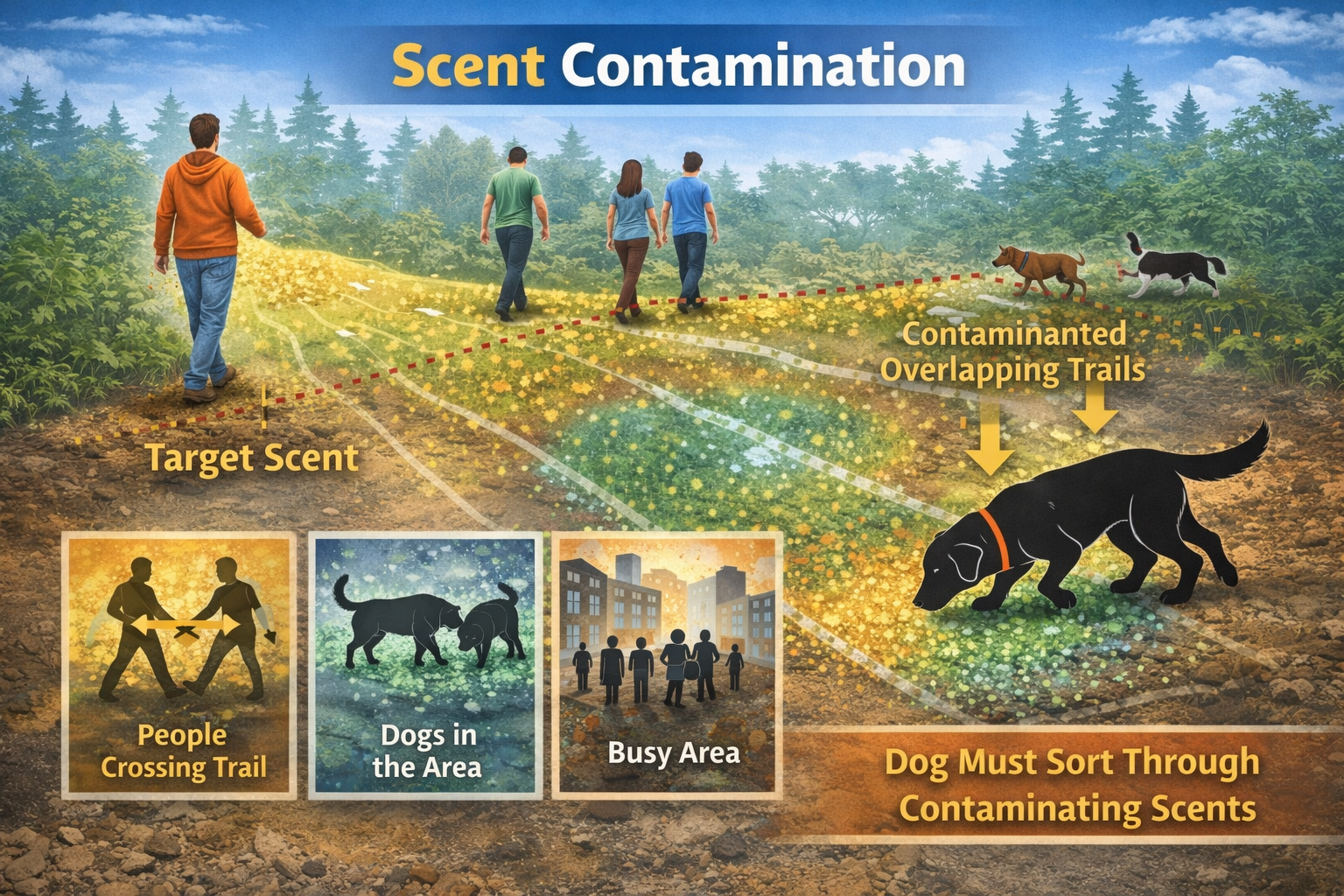
Scent Contamination
In real-world environments, scent rarely exists in isolation.
Areas often contain scent from multiple people, animals and environmental sources. This creates scent contamination.
Contamination occurs when other scents cross or mix with the target scent.
Examples include:
• People walking across a trail
• Dogs running through the area
• Busy urban environments
A well-trained scent dog learns to separate the target scent from other competing scents.
What this looks like during training
Dogs may briefly investigate another scent before returning to the target scent.
Handlers must avoid panicking or interfering during these moments.
Dogs are capable of sorting through multiple scent sources far better than we are.
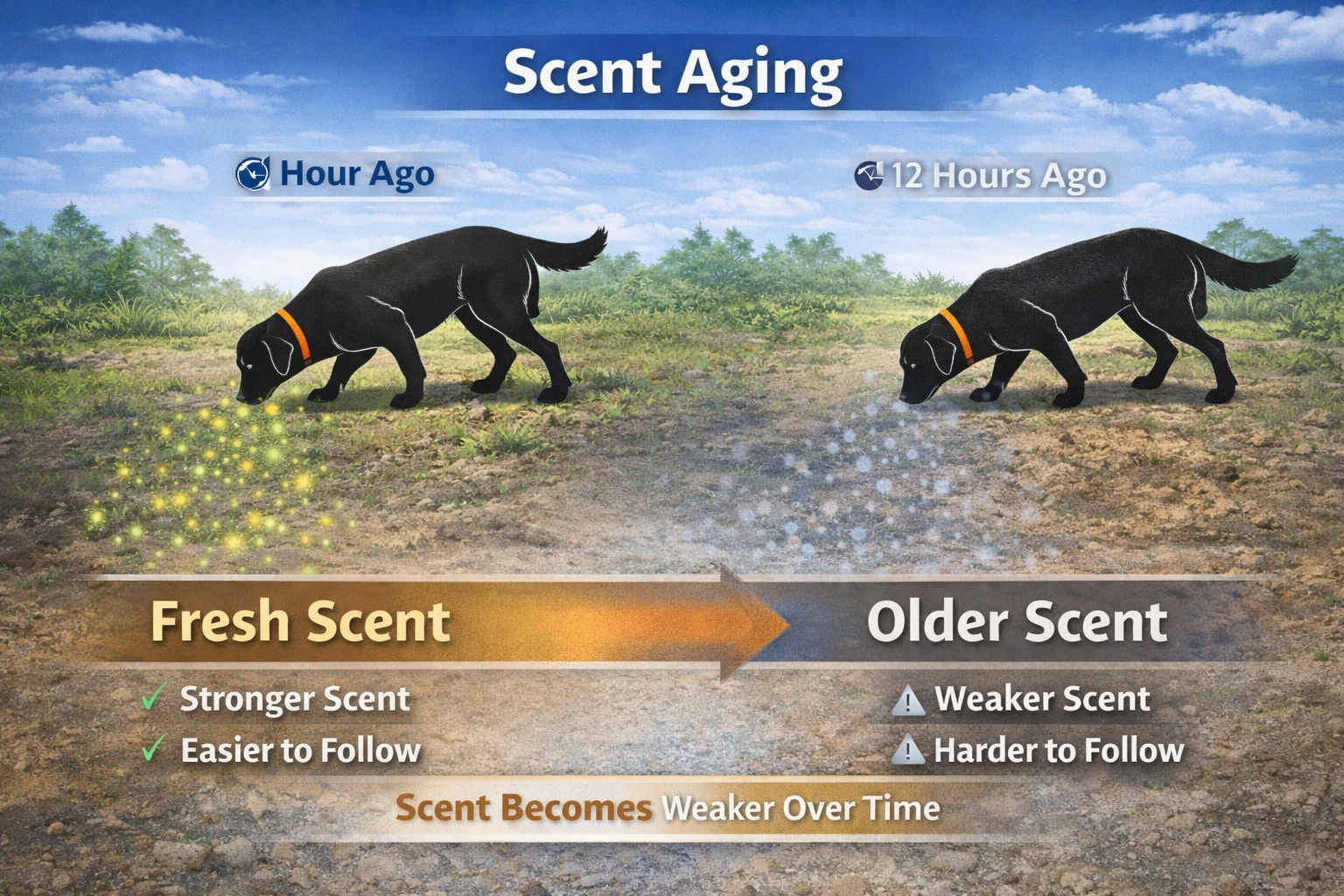
Scent Age
The age of the scent is one of the most important factors affecting scent work.
Fresh scent contains a higher concentration of scent particles and is generally easier for dogs to follow.
As time passes:
• Scent particles disperse
• Environmental factors break scent down
• Other scents cross the area
Older tracks therefore become more difficult.
What this looks like during training
On older tracks you may see the dog:
• Working slower
• Casting more frequently
• Rechecking areas
This is normal behaviour as the dog works to locate weaker scent.
Ground Disturbance
In traditional tracking work, dogs often follow ground disturbance in addition to human scent.
When a person walks across terrain they disturb the environment by:
• Crushing vegetation
• Breaking insects
• Compressing soil
This disturbance creates additional scent sources that dogs can follow.
Tracking dogs typically work with their nose close to the ground to locate this disturbance.
Trailing dogs often rely more heavily on human scent carried through the air and environment.
Understanding the difference helps handlers interpret what their dog is doing.
How Handlers Should Respond
Knowing these scent behaviours is useful, but the real value comes from how you respond as a handler.
There are several simple principles every handler should follow.
1. Observe before reacting
When your dog changes behaviour, watch carefully before intervening.
Ask yourself:
• Is the dog solving a scent problem?
• Has the dog encountered drift or pooling?
• Is the dog working into a scent cone?
Very often the dog is correct.
2. Manage the line properly
Allow the dog enough freedom to explore scent naturally.
A tight line can prevent the dog from investigating scent movement and solving problems.
Your job is to support the dog, not control every movement.
3. Trust the dog
Dogs have evolved to follow scent.
When handlers constantly interrupt or direct the dog, they often make the job harder.
The more the dog is allowed to work independently, the stronger its scenting ability becomes.
The Bigger Picture
Tracking, trailing and scent detection are not just about teaching a dog to follow scent.
They are about building a working partnership between dog and handler.
When handlers understand scent behaviour terminology such as:
• scent cones
• scent plumes
• scent drift
• scent pooling
• contamination
they begin to interpret their dog’s behaviour more accurately.
This understanding builds confidence for both the dog and the handler.
Over time, you will start to recognise subtle changes in your dog’s movement and behaviour that tell you exactly what is happening in the scent picture.
Final Thoughts
Scent work can appear complicated when you first begin. There are many variables in the environment that affect how scent behaves.
However, the principles remain simple.
Dogs follow scent as it exists in the environment. The handler’s job is to recognise how that scent behaves and allow the dog to work.
When you understand scent behaviour terminology and begin to recognise these patterns during training, you will become a far more effective handler.
The result is a dog that works with confidence, solves problems independently, and performs at a much higher level.
And ultimately that is the goal of any good scent dog team.